
In new audio recording, Diocese of Chiclayo calls pope’s investigation a “joke”
SNAP to file updated Vos estis lux mundi complaint using new evidence of cover-up
FOR IMMEDIATE RELEASE: December 4, 2025
Chicago, Ill. – Survivors of clergy sexual abuse held a press conference this morning (Thursday December 4, 2025) to release new evidence showing Pope Leo XIV wielded his new papal authority to avoid testifying about his involvement in covering up child sex abuse in Peru.
This evidence included internal Vatican documents, emails from Pope Leo, and recordings of meetings with church officials discussing the cases of sexual abuse reported by Ana María Quispe Díaz and two other victims from the Diocese of Chiclayo in Peru.
Quispe previously traveled to Chicago in July to testify in a press conference alongside representatives of SNAP.
Her full statement regarding the recent updates in her case can be found here.
Él no lo considera un delito / He doesn’t consider it a crime
On April 9, 2025, as Pope Francis’ prognosis was questionable following a five-week hospital stay, Fr. Giampiero Gambaro, OFM Cap., vice rector of the Universidad Católica Sedes Sapientiae, called Ana María Quispe Díaz and two other clergy abuse victims to a meeting at the Bishopric of Carabayllo in Lima on April 23rd. Gambaro, the delegate instructor appointed by the bishop of Chiclayo to carry out the administrative work in the canonical investigation into Quispe and the other victims’ reports, can be heard in newly released recordings of this meeting making several shocking claims about Cardinal Robert Francis Prevost, now Pope Leo XIV, and his management of their case.
In the April 23 meeting, taking place just two days after Francis’ death, Gambaro affirmed that one of the accused priests, Fr. Eleuterio Vásquez Gonzáles (Fr. Lute) had acknowledged the acts of abuse they reported, stating, “It may be that he considers it a sin. But he doesn’t consider it a crime.” (🎧Listen to audio with English transcription)
The “sins” in question include the following acts detailed in victims’ direct reports to Prevost:
In a 2022 in-person meeting with Prevost, Ana María Quispe Díaz and two other victims reported that when they were between the ages of 9-14 years old, Fr. Lute took off his clothes and, while making sexually inappropriate comments, touched his own genitals as well as the private areas of the victims on several separate occasions on mission trips to rural towns outside Chiclayo.
In a 2020 report made to Prevost by phone, Ana María Quispe Díaz alleged that Fr. Ricardo Yesquén Paiva kissed her on the mouth when she was 10-years-old, placing her on his lap and inserting his tongue, in the rectory of a parish in Chiclayo.
Despite assertions by Prevost that the accused priests ceased exercising public ministry, Facebook photos show that both Lute and Yesquén continued public ministry during Prevost’s tenure as Bishop of Chiclayo.
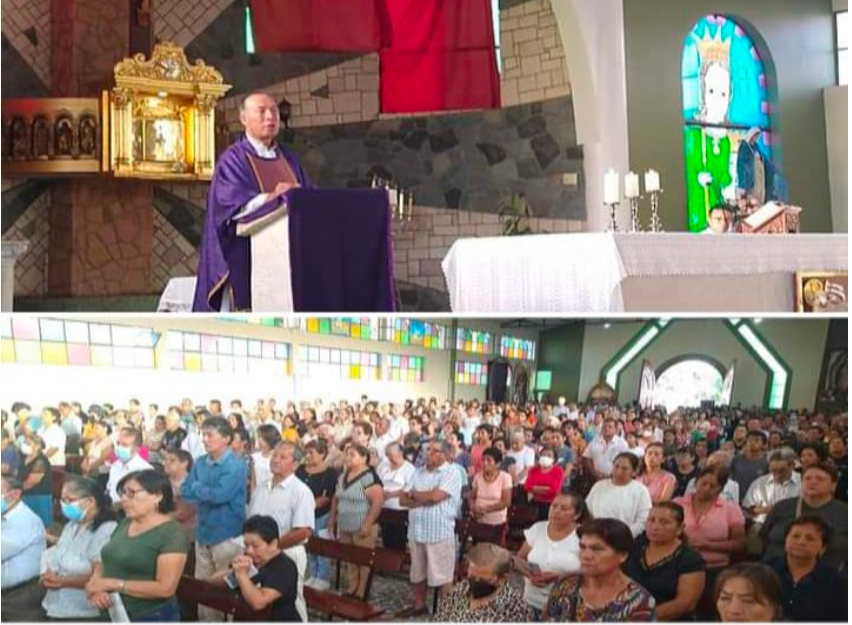
Lute leads a eucharistic celebration on March 26, 2023 at Parroquia San Jose Obrero, posted on the parish’s official Facebook page
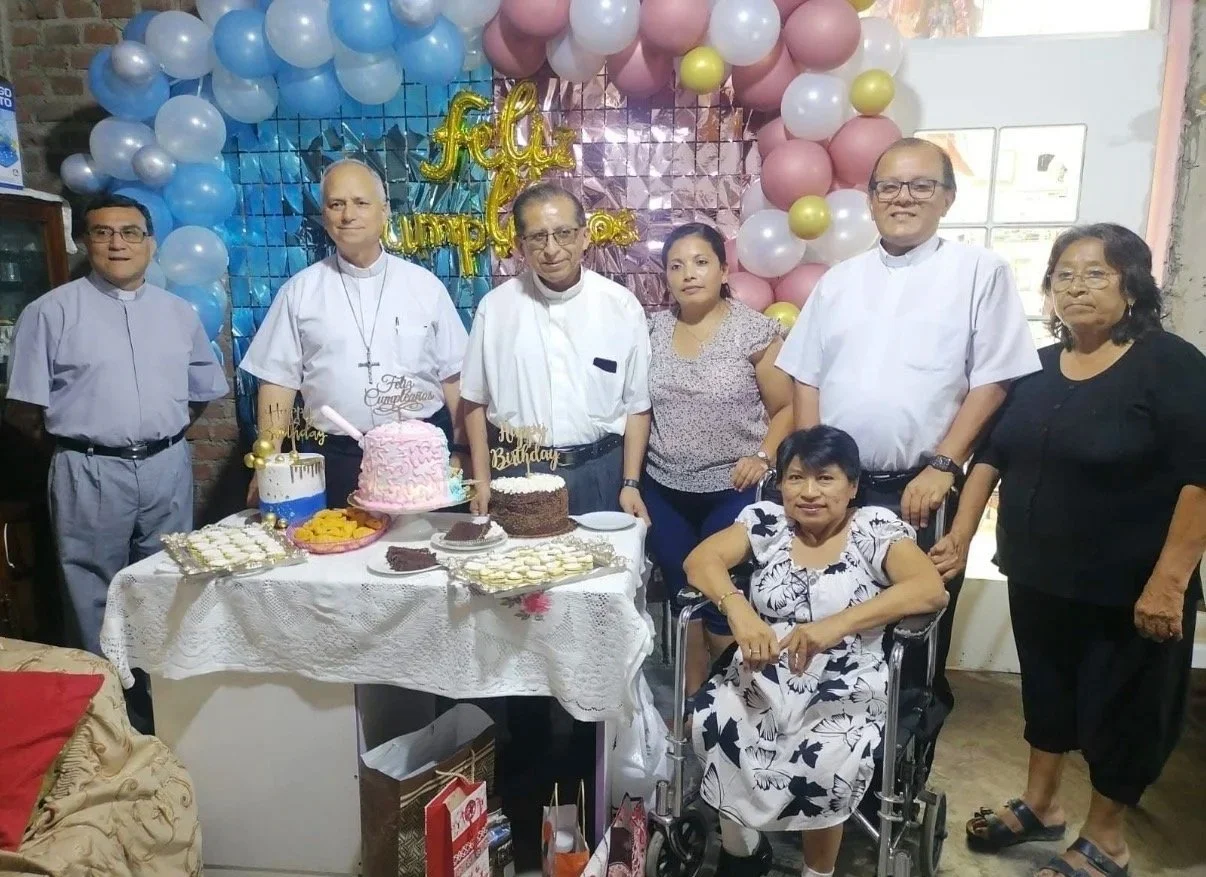
In a January 2023 photo posted on Facebook, Prevost can be seen standing next to Yesquén, dressed in clerical garb, at a birthday celebration for the priest accused of sexually assaulting a 10-year-old girl
Though most of the media reports surrounding Quispe’s case have focused on Lute, Yesquén also continued representing himself as a priest, despite statements by Prevost that he suffered from a debilitating physical and neurological condition that would have prevented him from exercising a proper defense in a canonical investigation. In an official statement from the Diocese of Chiclayo on September 10, 2024, responding to Quispe’s public statements, the church wrote, “Regarding the case of Father Ricardo Yesquén, due to the serious degenerative disease he suffers from, he is unable to defend himself, and therefore a case cannot be opened against him. He has not exercised the priestly ministry for years.”
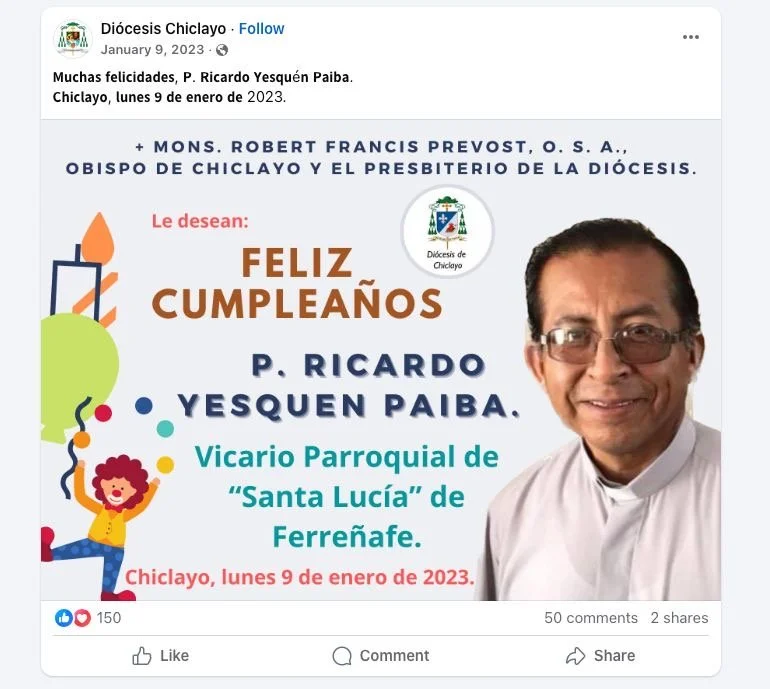
Contrary to the Diocese of Chiclayo’s claim that Yesquén had not exercised priestly ministry for years, a post from the official diocesan Facebook page wished Yesquén a happy birthday on behalf of Prevost, referring to him as the Parochial Vicar of Santa Lucía de Ferreñafe in January 2023.
According to the victim’s testimonies and available evidence, Prevost appears to have violated canon law quite significantly in his failure to initiate proper canon law proceedings into alleged crimes committed by both priests, offer canonical legal advice, procedural transparency, and spiritual and psychological support, and take effective precautionary measures to protect his diocese and the public from the potential dangers posed by Lute and Yesquén. Furthermore, his statement to the victims that a canonical investigation could not be initiated in the absence of a civil complaint is not consistent with canon law.
In the April 23 meeting, Gambaro characterized Prevost’s initial investigation of the victims’ claims as una tomadura de pelo, a “joke,” and admitted that SNAP’s March 25, 2025 filing of a Vos estis lux mundi report with the Vatican triggered the meeting, saying, “SNAP, in the wake of the conclave, to determine which cardinals should not be voted for as pope, included Prevost because of this case.”
Una tomadura de pelo / A joke
Gambaro went on to state that Prevost’s “preliminary investigation was very poorly conducted. The [Dicastery of the] Doctrine of the Faith claims that the case is closed because the prosecution declared it was time-barred, that it had expired under Peruvian law…But the church’s statute of limitations is clearly quite different.”
Gambaro noted that this is an exceptional argument, saying, “This is the first time I’ve dealt with this type of situation where they invoke the statute of limitations under civil law in this way.” He adds that an unknown church official, believed by the victims to be Prevost, “signed a letter saying the [canonical] process should not be carried out.” (🎧Listen to audio with English transcription
Calling Prevost’s investigation a “joke” in the presence of the three victims, Gambaro admitted, “They asked [Lute] practically nothing. He didn’t answer anything.” (🎧Listen to audio with English transcription)
These characterizations by the delegate instructor stand in stark contrast to public statements regarding Quispe and the other victims’ case by Prevost and other high-ranking Catholic officials.
In a July 15, 2024 email to InfoVaticana, shared with SNAP, Prevost responded to a question surrounding the reasoning behind Lute’s departure from his parish in Etén and relocation to Santa Cruz, writing, “This was one of the precautionary measures. Santa Cruz is the (civil) province where his family lives. He went to their home without publicly exercising his ministry.”
This claim is reiterated in an authorized Spanish-language biography, Pope Leo XIV: Global Citizen, Missionary of the 21st Century, authored by Elise Allen, a journalist who considers herself a friend of Prevost. Allen writes, “Father Vásquez Gonzales denied any abuse, claiming the situation was a misunderstanding. However, Bishop Prevost opened a preliminary investigation and imposed restrictions, banning him from public ministry and, consequently, from serving as a parish priest and hearing confessions, although he could still celebrate Mass privately.”
Not only is this reporting contradicted by Gambaro’s statements and the photos of Lute saying public mass posted on official diocesan Facebook pages during Prevost’s tenure in Chiclayo, Rev. Julio Ramírez, the priest tasked with overseeing the Diocese of Chiclayo’s “Listening Center” under Prevost’s leadership, told Quispe in a recorded phone conversation on November 11, 2023, “What Monsignor Roberto [Prevost] did was take him out of (Chiclayo) and leave him at his home in Santa Cruz…I’m not going to lie to you, it’s not that they took away his licenses. Monsignor Roberto’s only comment was that he shouldn’t come to Chiclayo.” (🎧Listen to audio with English transcription)
In another audio recording from March 2025, Gambaro can be heard explaining very clearly to the victims the very limited extent of Lute’s restrictions, confirming “Prevost’s decree of April 2022 states, (1) to prohibit Father Eleuterio from administering the sacrament of penance, (2) the exercise of the functions inherent to his office as parish priest in the parish of Santa María Magdalena, in the city of Etén, and nothing more, nothing more. It does not prohibit him from celebrating Mass, receiving it, or anything else.” (🎧Listen to audio with English transcription)
Buenas noticias / Good news
In the April 23 meeting, Gambaro presented an update on Lute’s status to the victims, characterizing it as “good news,” stating that Lute had requested voluntary dispensation from the priesthood, citing the psychological exhaustion their accusations had caused him, framing Lute as a victim of the three women who reported he had abused them as young girls. Gambaro told the victims that this meant there would be no further investigation of the abuse.
In response, the victims requested two things:
A letter of apology for the handling of the case and public statements made by the diocese denigrating Ana María Quispe Díaz’s testimony
Financial reparations to cover the cost of psychological and psychiatric care - services that are required under Vos estis lux mundi, but were not provided to the victims prior to Prevost’s election in the May 2025 conclave.
Over the course of the next several months, Quispe and the other victims exchanged multiple letters with Gambaro and the Diocese of Chiclayo concerning the lack of public apology, the Diocese of Chiclayo’s instructions to avoid speaking to the press, severe delays in reimbursements for psychological care, and false statements made about the case by high-ranking Vatican officials.
Though the current Bishop of Chiclayo Edinson Farfán and other unnamed Vatican sources speaking to Crux have stated that the victims had received adequate psychological care through the Diocese of Chiclayo’s “Listening Center,” the diocese has since delayed promised payments for the victims’ psychological care – leading recently to a brief termination of services and medication.
This is evidenced through the communication between the victims and the Diocese of Chiclayo from July through October 2025.
On November 11, 2025, Gambaro wrote to Quispe and the other victims informing them that Lute had been granted voluntary dispensation on September 15, 2025. In his letter, he makes several statements that are at demonstrable odds with his characterization of aspects of the case in the April 23, 2025 meeting with the victims and canon law prescriptions.
In Quispe’s public response to this news, she states, “Granting a [dispensation] to Eleuterio Vásquez is also especially irresponsible given that there are witnesses who have publicly stated to the media that he frequently took other children to the same room where we were abused. That information, which should have triggered every alarm, demanded a deep and urgent investigation — not the definitive closure of the case.”
Gambaro astonishingly claims that the “receipt and handling of the complaints” have followed canon law. One might ask – does Gambaro believe that an investigation in which the accused is not compelled to answer basic questions about allegations, one that he himself called a “joke” – is canonically sanctioned?
With no acknowledgement of the anxiety and emotional pain produced by the diocese’s delays in reimbursing the costs of psychological and psychiatric care, detailed in the six letters victims sent to the Diocese of Chiclayo in September and October, Gambaro claims that the diocese is fulfilling its duty under canon law for the “well-being” of the victims.
Finally, Gambaro frames Lute’s dispensation as a loss of “dignity” and “rights,” implying, as he did in the April 23 meeting that this is a punishment for Lute though he has been granted an “honorary discharge” from the priesthood with no trial, no finding of guilt, and no public record of his crimes.
Most significantly, the only person in the 1.4 billion member Catholic Church empowered to sign off on this dispensation, is the man who stands to lose the most by an investigation and trial: Pope Leo himself, who serves as both judge and interested party in a case that directly implicates his own oversight.
Creí…que querías que renunciara / I thought…you wanted me to resign
Pope Leo revealed to Elise Allen in his authorized biography that he understood his vulnerability in this case from Chiclayo and that it caused him a significant amount of anxiety leading up to the conclave.
In Pope Leo XIV : Global Citizen, Missionary of the 21st Century, the new pontiff recounted to Allen his anxiety leading up to the conclave. He first describes a meeting with Pope Francis immediately following SNAP’s Vos estis lux mundi complaint saying, “I received a phone call asking me to go secretly to Santa Marta, and they told me, "Don't tell anyone." The Pope wanted to see me. And they didn't tell me anything else. So I didn't tell anyone in the office, not my secretary, not anyone. I simply disappeared and went. I went up the service stairs, and no one saw me. Then, after he'd told me what he wanted, which concerned work, bishops, and other matters he had in mind, I said to him, "For your information, Holy Father, I thought that perhaps the reason you called me that way was because you wanted me to resign."
Pope Leo further acknowledged that his handling of the aforementioned abuse cases in Chiclayo were a cause for concern with other Catholic cardinals, telling Allen, “But I also thought about the case you asked me about before [the one of the complaints in Chiclayo, sic], which worried some of the other cardinals, whether this issue of sexual abuse could be a problem.”
In an August 2, 2025 email, just two days after Quispe spoke at a press conference in Chicago “for herself, for her family…and for children in danger” calling for justice, Pope Leo wrote to InfoVaticana regarding her case. He begins by saying, “Against all the advice I've been given, I'll answer the main question briefly.” This question pertained to his alleged knowledge of an email sent by Quispe to request information about her case to be corrected on InfoVaticana’s website. On the eve of the conclave, the reporter described a conversation with Prevost in which this email was mentioned.
This reporter later wrote, “What surprised me, Your Holiness, was that you were already aware of that email just a few hours after it arrived. No one else knew about it. And it was you yourself who, in that brief but difficult encounter we had at the entrance to the Holy Office, made explicit reference to its contents. Since then, I haven't been able to stop wondering how it came into your possession and why.”
Pope Leo denied knowledge of the email, but wrote that “recent events,” implying Quispe’s public advocacy, “will only cause her more harm, because they continue the revictimization of someone who is seeking peace and healing.” He continued, “I believe that the insistence on publishing the same stories over and over again only harms Ana María and [the other victims].” Despite these comments that ignored Quispe’s agency and thoughtful decision to speak publicly, painting her rudderless and impressionable, the pontiff spoke at length about Quispe’s case in interviews with Elise Allen that were published in his authorized biography the following month.
Conclusion
SNAP will file a updated Vos estis lux mundi complaint next week with the Dicastery for the Doctrine of the Faith and other Vatican and civil authorities, including the American and Peruvian ambassadors to the Holy See and the UN Committee on the Rights of the Child, urging a full investigation into Pope Leo XIV’s role in authorizing the voluntary dispensation of Lute and suppressing the Chiclayo case. This case from Chiclayo is not isolated, and sadly, not unique – it exposes a system that allows bishops and cardinals to control and close cases that implicate themselves.
For this reason survivors have insisted on a binding, universal zero tolerance law that would eliminate the structures that allow the Catholic hierarchy to cover-up abuse and shield offenders with impunity.
SNAP Survivors Network is the world’s oldest and largest community of survivors of clergy and institutional sexual abuse. Through public action and peer support, SNAP is building a future where no institution is beyond justice and no survivor stands alone. Our global community works to end sexual abuse in faith-based organizations by transforming laws, institutions, and lives.